
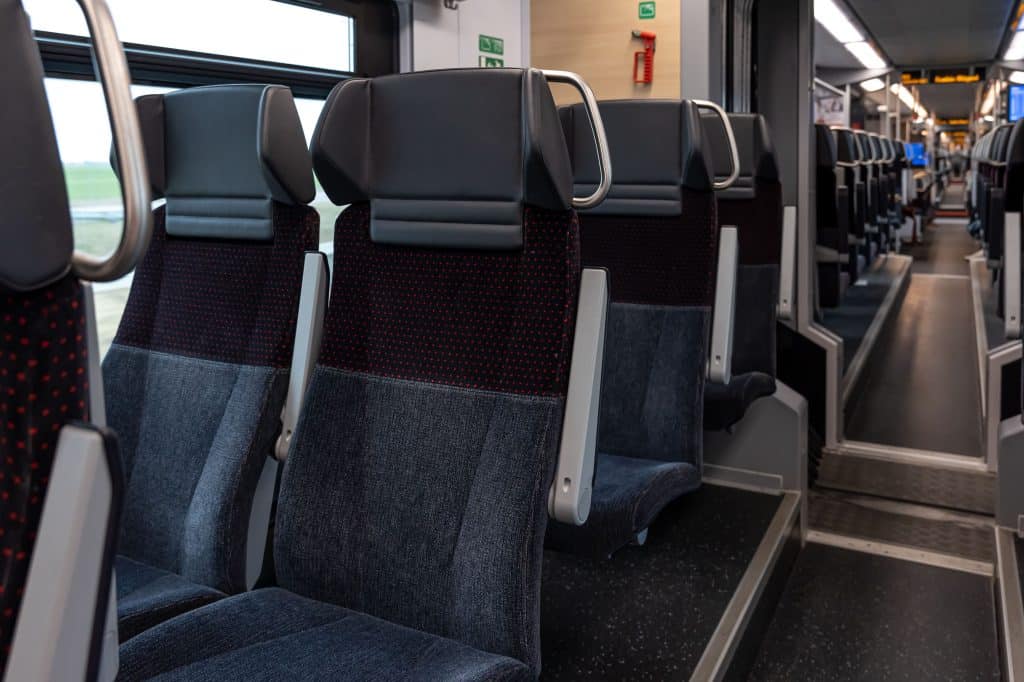
Take any busy bus line at rush hour, and you’ll see the same seats are used by hundreds of people in a single day. Hands, bags, coats, occasional spills, everything ends up touching the upholstery at some point. That’s why hygiene in public transport is also about choosing materials that cope well with constant contact and frequent wipe-downs while still feeling comfortable and welcoming for passengers.
Antimicrobial fabric for bus seats: what it does (and what it doesn’t)
When we specify antimicrobial fabric for bus seats, we’re talking about upholstery designed to help inhibit bacterial growth on the surface. In plain terms, it can slow down how quickly bacteria multiply between cleaning cycles. On high-traffic routes, that extra support can be useful, especially when vehicles need to stay presentable from the first service to the last.
It’s also worth clearing up a common misunderstanding. Antimicrobial fabric for bus seats isn’t a replacement for good cleaning protocols, and it doesn’t turn a cabin into a sterile environment; consider it to be a material feature that works alongside normal routines, helping you maintain a cleaner baseline in the time between scheduled cleans.
Done well, passengers won’t even notice it’s there, and that’s the point. The aim is a seat that looks and feels comfortable, stable, and consistent across the fleet. Antimicrobial fabric for bus seats should support that experience quietly, without changing the look of the interior or the way the fabric feels to the touch.
Cleaning reality
Operators don’t clean buses the way you clean a living room. The products are stronger, the wipe-downs are more frequent, and turnaround times are tight. So when we discuss hygiene, we also look closely at how the upholstery behaves with real cleaning chemistry, because a seat that degrades quickly becomes harder to keep looking clean.
Alongside antimicrobial fabric for bus seats, we consider chemical resistance (how well the surface tolerates disinfectants), finish stability (whether it stays uniform after repeated cleaning), and construction details such as seams and edges.
On the other hand, headrests, side bolsters, and arm areas usually see the most contact, which means they often see the most cleaning as well. Extending antimicrobial fabric for bus seats to these high-touch zones, or pairing it with matching technical surfaces, makes hygiene practices more consistent across the whole cabin.
Durability, passenger confidence, and fleet consistency
A well-maintained interior changes how people feel about a service. Clean-looking seating supports trust, and when antimicrobial fabric for bus seats is combined with materials that resist staining and hold their colour, the cabin tends to look fresher between deep cleans.
There’s a financial angle too, and it’s a practical one. Upholstery that wears unevenly across a fleet creates patchwork interiors, more downtime, and higher re-trim costs. Specifying antimicrobial fabric for bus seats within a broader performance brief helps keep vehicles consistent and maintenance planning predictable.
And, at the end of the day, seats still need to feel good, because public transport is about moving people, not ticking boxes. The best solutions treat antimicrobial fabric for bus seats as part of a balanced interior: comfortable for passengers, robust for operators, and built for the reality of daily service.
Reducing bacterial transmission in public transport is a shared effort, and antimicrobial fabric for bus seats can support that system by helping maintain a cleaner baseline between cleans, especially on busy routes with high turnover.